

The lowest price on a quotation is not always the lowest cost after delivery. Two suppliers may offer the same product at a similar price per ton, while differences in grade, sizing, net weight, packaging, loading capacity, transport responsibility, and payment terms make one offer far more practical than the other.
When comparing fresh produce supplier quotes, GCC importers need to place each offer on the same commercial basis. A quotation for premium-grade tomatoes in export cartons cannot be compared directly with an offer for mixed-grade tomatoes packed in a heavier or weaker carton. The product name may be the same, but the value received by the importer is different.
At Kian Export, we believe that a useful quotation should help the buyer understand what will be supplied, how it will be packed, where the supplier’s responsibility ends, and which costs remain for the importer.
What Fresh Produce Supplier Quotes Should Clearly Include
A professional quotation should contain enough information for the buyer to evaluate the product and calculate the expected purchasing cost. A price without a clear specification leaves too much room for different interpretations.
At minimum, the offer should state:
- Product name and variety
- Country of origin
- Quality grade
- Size, weight, or count range
- Maturity or colour requirement
- Packaging type
- Net weight per package
- Total order quantity
- Incoterm and named delivery point
- Currency
- Payment conditions
- Offer validity
- Estimated loading period
- Required documents
If one of these points is missing, request clarification before comparing the offer with another supplier. A vague quotation may look attractive at first but can create disputes when the shipment is prepared.
Buyers can review Kian Export’s complete fresh produce collection to identify the products available for wholesale and export enquiries.
Compare the Same Product Specification
The first step is to confirm that all suppliers are quoting for the same commercial specification. Variety, size, grade, maturity, appearance, and defect tolerance can significantly affect price.
For example, one tomato supplier may quote for uniform fruit within a defined size range, while another may offer mixed sizes. A watermelon offer may refer to a specific weight range, while a competing offer includes smaller and larger fruit in the same shipment.
Ask each supplier to confirm:
- Exact variety or commercial type
- Required size range
- Permitted size tolerance
- Maturity stage at loading
- Acceptable cosmetic defects
- Maximum damaged or rejected quantity
- Whether the offer covers one grade or mixed grades
For product-specific requirements, buyers can review our fresh tomato supply page and watermelon export page.
Check Net Weight Instead of Carton Weight
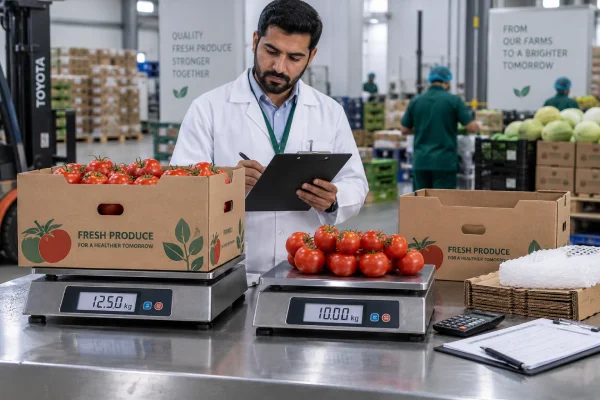
Carton weight can refer to gross weight or net product weight. Gross weight includes the product and packaging, while net weight represents the actual fruit or vegetables inside the package.
This difference matters when comparing fresh produce supplier quotes. A carton described as 10 kilograms may contain 10 kilograms of produce, or its total packed weight may be 10 kilograms after including the carton and internal materials.
The quotation should state:
- Net product weight per carton
- Gross packed weight per carton
- Permitted weight tolerance
- Number of cartons
- Total net product weight
- Total shipment gross weight
Calculate the cost per kilogram based on the actual net product quantity. This provides a more accurate comparison and prevents packaging weight from making one quotation appear cheaper than it really is.
Evaluate Grade and Quality Tolerances
Terms such as premium, Grade A, first grade, and export quality are useful only when they are supported by measurable requirements. Suppliers may use the same grade name for products with different levels of size uniformity, colour, firmness, and appearance.
A better specification defines what is acceptable. For tomatoes, this may include firmness, colour stage, diameter, shape, and freedom from cracks. For melons and watermelons, the specification may cover weight range, maturity, rind condition, internal colour, and sweetness.
Buyers should ask how quality will be checked before loading. Recent photographs, videos, sample inspections, or a third-party inspection can help document the shipment’s condition. The inspection method and the party responsible for its cost should be agreed upon before the order is confirmed.
Compare Packaging and Palletisation Costs
Packaging is part of the product’s protection during transport. Weak cartons, incorrect ventilation, poor stacking, or unsuitable internal arrangements can increase bruising, compression, moisture damage, and product loss.
When reviewing packaging, compare:
- Carton, crate, bin, or bag type
- Material quality and strength
- Net weight per package
- Number of pieces per carton
- Ventilation design
- Internal dividers or protective materials
- Labelling and printing
- Pallet type and dimensions
- Cartons per pallet
- Wrapping and securing method
Confirm whether packaging, printing, pallets, corner protectors, and wrapping are included in the price. Differences in these items can explain why fresh produce supplier quotes for apparently similar products do not carry the same price.
Suitable packaging may cost more at origin but reduce repacking, sorting, and product loss after arrival.
Read the Incoterm and Delivery Point Carefully
A product price cannot be evaluated without knowing where the supplier’s responsibility ends. An EXW offer, for example, covers a different scope from a quotation that includes inland transport or delivery to a named port.
The quotation should state both the Incoterm and the exact named location. General terms such as “FOB price” or “delivered price” are incomplete when no port, terminal, warehouse, or border point is specified.
Check which party is responsible for:
- Inland transport
- Loading
- Export customs procedures
- Terminal and handling charges
- Main international transport
- Insurance
- Destination clearance
- Duties and local charges
- Final delivery
Once these responsibilities are clear, the importer can estimate the landed cost instead of comparing only the supplier’s initial price.
Calculate the Expected Landed Cost
The practical cost of an order is the total amount required to bring the saleable produce to the buyer’s receiving point. This calculation may include the product price, packaging, inspection, inland transport, documentation, freight, insurance, clearance, duties, local handling, storage, and final delivery.
A useful landed-cost calculation should also consider potential commercial loss. If a cheaper shipment arrives with more damaged fruit, mixed sizes, or weak packaging, the cost per kilogram of saleable produce may be higher.
Use this basic approach:
Expected landed cost ÷ expected saleable net weight = estimated cost per saleable kilogram
The result will not predict every possible expense, but it provides a more realistic comparison than the quoted price per ton.
Review Payment Terms and Offer Validity
Fresh produce prices can change with the season, crop availability, order volume, packaging costs, transport conditions, and currency movements. For this reason, suppliers normally issue quotations with a limited validity period.
Review:
- Required deposit
- Balance payment schedule
- Accepted payment method
- Currency
- Bank charges
- Conditions for releasing documents
- Offer validity
- Conditions for price revision
- Cancellation terms
An offer with a slightly higher price may provide better payment conditions, more precise specifications, or clearer supplier responsibility. These factors affect both cash flow and purchasing risk.

Confirm Supply Capacity and Loading Schedule
A supplier should be able to explain whether the required volume is available within the requested loading period. Large quantities collected too quickly from unrelated sources may create inconsistency in variety, size, maturity, and quality.
Ask whether the produce comes from the supplier’s own farms, contracted growers, or open-market purchasing. Also confirm how the products are selected and whether the full quantity can be packed according to the same specification.
Kian Export works through direct farms and trusted growers. Our farm-based supply approach helps us monitor cultivation, harvest timing, product selection, and export preparation more closely.
GCC Buyer’s Checklist for Fresh Produce Supplier Quotes
Before choosing a supplier, check whether every offer answers these questions:
- Is the product variety clearly identified?
- Are grade, size, maturity, and tolerances defined?
- Is the stated package weight net or gross?
- Is the total net product quantity confirmed?
- Are packaging and pallet costs included?
- Is the exact Incoterm and delivery point stated?
- Are inspection arrangements explained?
- Are the required export documents included?
- Is the loading period realistic?
- Are the payment terms and validity period clear?
- Has the landed cost been calculated?
- Does the supplier have access to the required volume?
- Are recent product and packing images available?
- Is there a clear process for approving the shipment before loading?
If an offer does not answer these questions, request a revised quotation. Written clarification protects both buyer and supplier and makes the order easier to manage.
Request a Detailed Quote from Kian Export
Kian Export supplies tomatoes, melons, cantaloupes, watermelons, and sweet corn to importers, wholesalers, and distributors across GCC markets. We prepare our offers according to product specifications, quantity, packaging, destination, Incoterm, and required loading period.
To receive comparable fresh produce supplier quotes, send each supplier the same enquiry and specification. If you would like an offer from Kian Export, include the product, variety, grade, size, quantity, packaging, destination, preferred Incoterm, and delivery period in your request.